
Central bank credibility intact for now
First, bonds. Confronted with a more populist turn in policy in recent years, we have consistently been of the view that more profligate fiscal policies would boost nominal growth and, by extension, corporate earnings. The ultimate constraint on this trend would be the extent to which bond investors would be willing to fund government spending.
For now, news on this front has been comforting for me. We saw a sell-off in bond yields in the second quarter driven by concerns about energy-induced stagflation but yields are back at fair value, rate expectations are more realistic, and an easing of tensions in the Middle East has alleviated the risk of inflation in the short-term.
Central banks have shown a willingness to “tap on the brakes” by raising rates and, for now, new Fed Chair Kevin Warsh’s policy pronouncements have indicated that he understands the importance of maintaining the credibility of the Fed.
Some commentators have been concerned about the step away from dot plots and forward guidance, but I view this as a sensible adjustment in a world of more frequent supply shocks and a return to the more pragmatic policies of the 1990s and 2000s. After all, the dot plot was only introduced in 2012.

The challenge of achieving real diversification in equities
What about equities? Here we are starting to see more extreme behaviour and expensive valuations. A lot is made of the concentration of the index but this misses the point slightly. In fact, compared to previous years, equity performance has been less dominated by the Mag 7, and indeed the Mag 7 in aggregate has been flat year to date.
Concentration has actually been a much bigger issue in terms of index contributions: this year, 20 stocks in MSCI ACWI have accounted for 74% of the return of the entire index with AI-related sub sectors such as memory being key drivers of this trend. Markets are chasing any capital equipment company with an AI datacentre angle, and in many cases, capitalising these earnings with high multiples.
Furthermore, exposure to the AI theme extends into private markets and, increasingly, part of the credit markets. That means that portfolios may be less diversified than asset class labels would imply. This is a key concern for our investors. Our latest Global Investor Insights Survey found that diversification is a top portfolio objective for 84% of respondents. How should investors manage this risk?
Several clients have asked me about allocating to equal cap weighted indices as a way of reducing concentrated exposure to AI. I fear that this tool is too blunt. Stock specific risks associated with concentrated contributions to return may not be effectively hedged with unrelated, arbitrarily selected stocks. Equal-weighting can introduce unintended stylistic tilts – such as weaker balance sheets, higher leverage, greater rate sensitivity, more volatile earnings, lower profitability and reduced liquidity.
At this point, I would favour style diversification as a means of managing AI risk and increasing the resilience of one’s portfolio. Here, recent trends have been extreme. Over 12 months, Momentum is up 33% vs 17% for Quality and 21% for Value. High quality businesses are now trading at valuations that appear attractive relative to their own history (see chart below).
The catalyst for this disconnected pricing is a pervasive fear of change and disruption by generative AI and the new competition it enables. The market is currently pricing very low growth into many exceptional companies, but history and our own fundamental analysis suggest that in many cases this fear is unwarranted.
Developed markets (ex-US) valuation spreads (top quintile compared to the market average) 1987 to April 2026
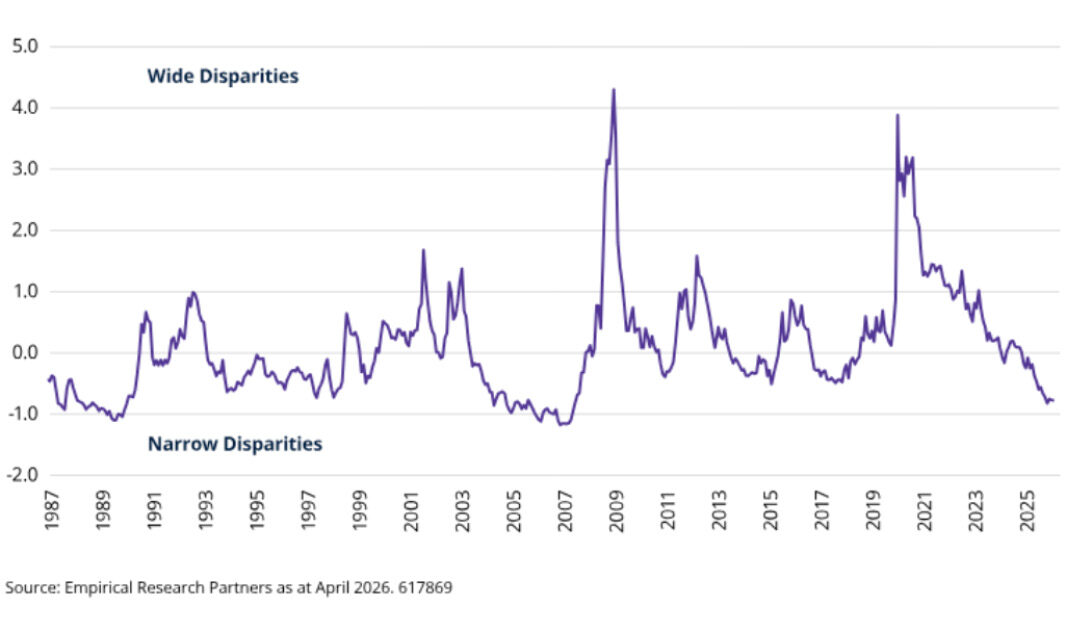
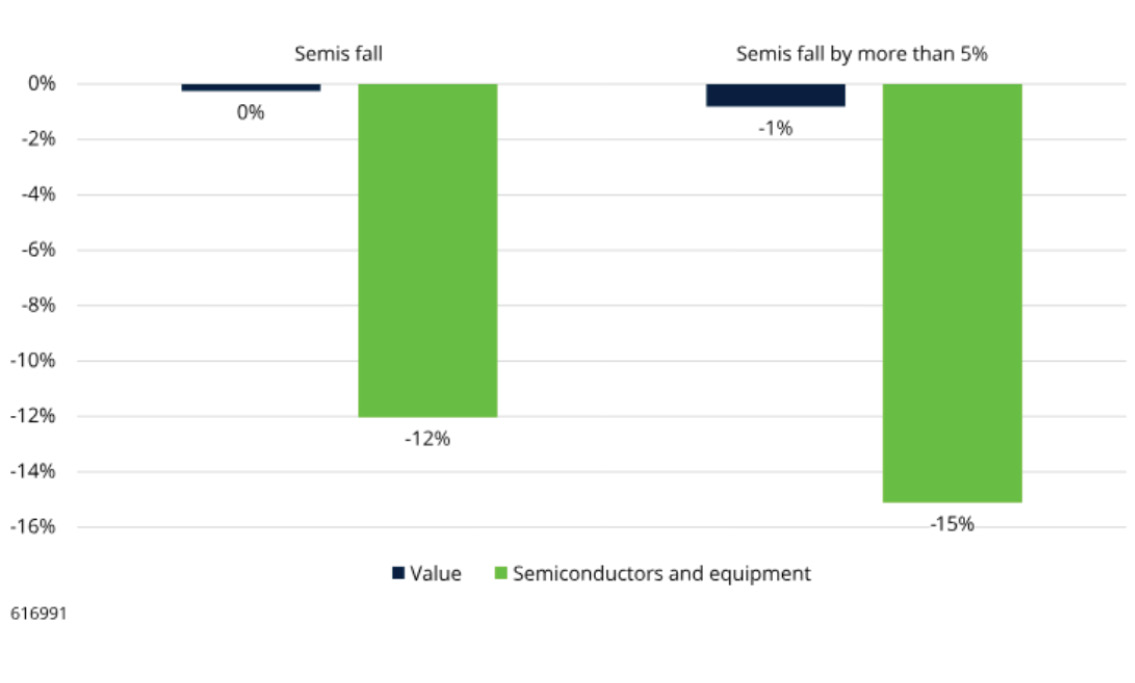
At the same time, active approaches to Value provide diversification to the AI theme. A disciplined Value selection process will steer investors to precisely where peak market euphoria is not – beware passive Value indices, however, as the AI theme has infiltrated some of the traditional value sectors such as utilities and real estate as well!
Value equities have delivered significantly better outcomes in down-markets for AI-stocks
Median quarterly return in quarters where semiconductors fall
Past performance is not a guide to future performance and may not be repeated.
Source: LSEG Datastream, S&P and Schroders. Value is MSCI pure value total return index, semis are S&P 500 semiconductors and equipment total return index. Semiconductors used as a proxy for Al-stocks. Data covers 30 June 1996 (inception of S&P 500 semiconductors & equipment index) to 31 December 2025. Chart isolates those quarters where semis fell in value; non-overlapping periods are used.
Where are risks accumulating?
I was at lunch with friends recently, and everyone was asking me about SpaceX. My investment advice is always dull – I believe in the compounding of returns and the careful balancing of risk and return through time so there’s no point coming to me for “exciting” stock tips.
I’m even more boring today: investors face a world where market concentration is high, economic exposures are increasingly interconnected and valuations are stretched.
The challenge is not simply finding opportunities but understanding where risks accumulate. It is more important than ever to understand what you own, how these exposures fit together and what role each exposure plays in your portfolio.
With low chance of recession and stable yields, we still see upside in equities, but my suggestion for now is to lean back from some of the frothiest parts of the equity market and diversify your equity risk.
Securities/sectors/regions mentioned are for illustrative purposes only and not a recommendation to buy or sell any security.
Source: Schroders
Disclaimers:
Important Information
For professional investors and advisers only. The material is not suitable for retail clients. We define “Professional Investors” as those who have the appropriate expertise and knowledge e.g. asset managers, distributors and financial intermediaries.
Investment involves risk.
This information is a marketing communication. The information contained herein is believed to be reliable. Where third-party data is referenced, it remains subject to the rights of the respective provider and must not be reproduced or used without prior consent.
Any data has been sourced by us and is provided without any warranties of any kind. It should be independently verified before further publication or use. Third party data is owned or licenced by the data provider and may not be reproduced, extracted or used for any other purpose without the data provider’s consent. Neither we, nor the data provider, will have any liability in connection with the third party data.
The material is not intended to provide, and should not be relied on for accounting, legal or tax advice, or investment recommendations. Reliance should not be placed on any views or information in the material when taking individual investment and/or strategic decisions.
Any references to securities, sectors, regions and/or countries are for illustrative purposes only.
Past performance is not a guide to future performance and may not be repeated. The value of investments and the income from them may go down as well as up and investors may not get back the amounts originally invested. Exchange rate changes may cause the value of any investments to rise or fall. Schroders has expressed its own views and opinions in this document, and these may change.
This document may contain “forward-looking” information, such as forecasts or projections. Any forecasts stated in this document are not guaranteed and are provided for information purposes only.
Schroders will be a data controller in respect of your personal data. For information on how Schroders might process your personal data, please view our Privacy Policy available at https://www.schroders.com/en-za/za/intermediary/footer/privacy-policy/ or on request should you not have access to this webpage.
For your security, communications may be recorded or monitored.
Issued in July 2026 by Schroders Investment Management Ltd registration number: 01893220 (Incorporated in England and Wales) which is authorised and regulated in the UK by the Financial Conduct Authority and an authorised financial services provider in South Africa FSP No: 48998.