An exchange-traded fund (ETF) is a pooled investment portfolio, just like a unit trust, invested according to a stated mandate. The key difference is that its units are listed and traded on a stock exchange, like ordinary shares. Investors therefore buy and sell ETFs through a stockbroker at prices that move throughout the trading day, unlike unit trusts, which have a single daily price (at 3pm).
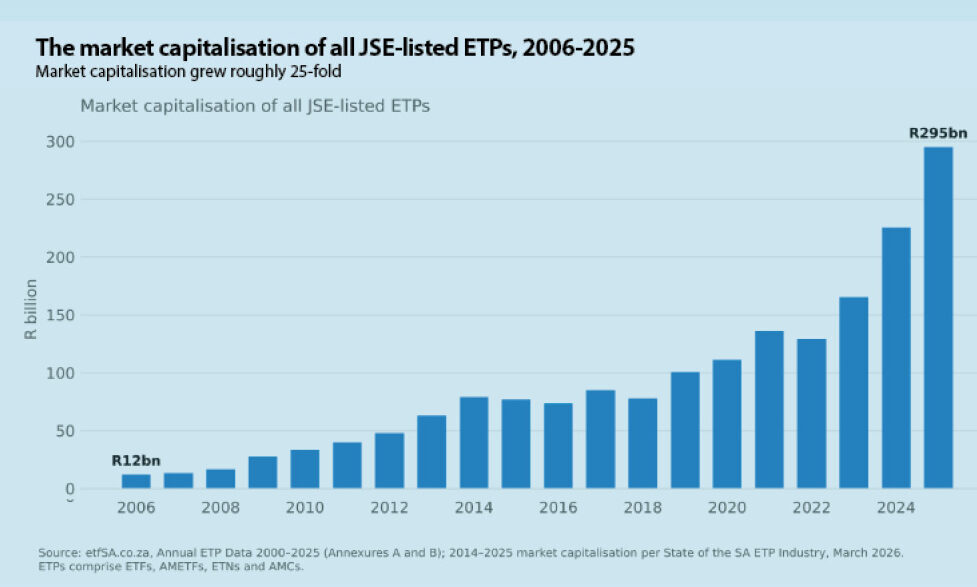
South Africa’s first ETF, the Satrix Top 40, listed on the JSE in November 2000. Twenty-five years later the local market had grown substantially: by February 2026 the JSE hosted 131 ETFs with a combined market capitalisation above R259-billion, having grown roughly 29% year on year. For context, global ETF assets stood at around US$22.1-trillion across nearly 17 000 listed funds by April 2026.
The regulatory context
With the exception of commodity ETFs, all JSE-listed ETFs are registered collective investment schemes (CISs). Just like unit trusts, they are governed by the Collective Investment Schemes Control Act 45 of 2002 (CISCA), supervised by the Financial Sector Conduct Authority (FSCA). In addition, they are subject to the JSE Listings Requirements.
The regulatory context carries three practical consequences for users of ETFs. First, like unit trusts, the underlying assets are held by an independent trustee or custodian and are ring-fenced from the manager’s own balance sheet. If the investment management company managing them fails, the assets remain the property of the investors.
Second, the disclosure requirements that apply to unit trusts apply to ETFs too: they must provide minimum disclosure documents, standardised total expense ratio and total investment charge reporting, and an ASISA classification.
Third, the protection for clients operates at two levels rather than one: an ETF client who is badly advised still has recourse against the advisor under the Financial Advisory and Intermediary Services Act 37 of 2002 (FAIS). Like unit trusts, CISCA adds the statutory trustee obligation to ensure that the manager complies with the deed and the Act, alongside FSCA supervision of the manager itself.
This second layer is present for a CIS-registered ETF but not for a commodity ETF or an exchange-traded note (ETN) as they do not fall under CISCA. The key exceptions to this regulatory arrangement are physically backed commodity ETFs such as the Absa NewGold, NewPlat, NewPalladium and NewGold-Platinum range, and Standard Bank’s gold, platinum, palladium and rhodium products. These are not collective investment schemes because CISCA’s scheme-in-securities approach requires a portfolio of listed securities.
As bullion is not a security, a physically backed bullion fund cannot register under the Act. Instead it is issued as debentures by a ring-fenced special purpose vehicle. Each debenture represents a fraction of a troy ounce backed by metal held with a custodian.
However, every ETF listed in South Africa, commodity or otherwise, is subject to the JSE’s Listings Requirements. Commodity products do not have CISCA oversight, a statutory trustee or FSCA supervision of the manager.
ETFs versus unit trusts
The key idea is that these two products present investors with the same underlying investment, but with a different product wrapper. In short, the differences are practical rather than philosophical. Neither wrapper is inherently superior. Which one an advisor prefers will depend on the pattern of contributions, the platform used by the client, and the fee structure the client actually faces. The key differences between the wrappers are:
Dealing: an ETF trades through a stockbroking or share-trading account at a live intraday price. A unit trust is bought from the management company or through a linked investment service provider (LISP) at a single price struck at the end of the day.
Minimums: ETFs generally have no minimum beyond the price of one unit, which is why they have become the default vehicle for small, regular contributions.
Costs: an ETF carries brokerage and a bid-offer spread on each trade, but typically no initial fee. A unit trust may carry initial and platform fees instead, as well as the underlying fund manager fee.
ETFs, exchange-traded notes (ETNs) and commodities
ETFs and ETNs are structurally different. Exchange-traded products (ETPs) is an umbrella term for pooled investments that are listed and traded on an exchange, which includes both ETFs and ETNs. Advisors need to understand these structural differences to advise on their use correctly.
Unlike an ETF, an ETN is an unsecured debt instrument issued by a bank. It promises a return linked to a reference asset or index. The investor buying the ETN therefore carries the issuer’s credit risk. Should the issuer become insolvent, the investment can be lost regardless of how the reference asset performed, and a mere credit downgrade can move the ETN’s price.
Precious-metals ETFs such as NewGold sit between the two. Like ETNs, they are issued as debentures, but like unit trusts, they are issued by a special purpose company owned by a trust with independent trustees rather than by the bank itself.
In addition, each debenture is backed by physical bullion held with a custodian. The investor therefore carries metal-price risk, not bank credit risk: were the originating bank to fail, the fund would continue unaffected. ETNs can give investors exposure to effectively any asset that has a quoted price, not just commodities. They do not fall under CISCA and are therefore highly flexible. Advisors considering these assets should conduct careful due diligence to avoid unwelcome surprises and difficult client conversations.
Investment exposure of ETFs: no longer a passive-only world
Traditional (non-actively managed) ETFs are required to track an index. The key for investors therefore lies in the definition of the index and its suitability for their needs. The first ETFs traced passive (ie market-capitalisation-based) indices. They were the vanguard of the passive investment revolution. Since then, however, they have evolved significantly.
It is important to understand, firstly, that the specification of underlying indices is no longer linked to these passive portfolios – a whole range of non-market-capitalisation indices have evolved and are available. Secondly, the introduction of actively managed ETFs (AMETFs) means that the specification of an index is no longer a requirement.
In October 2022, amendments to the JSE Listings Requirements took effect that permitted AMETFs to list for the first time, with the first listing following in May 2023. An AMETF is still a collective investment scheme regulated under CISCA, still exchange-traded, still subject to listing disclosure, but the manager exercises discretion rather than tracking an index. It has become one of the fastest-growing segments on the exchange.
The consequence for advisors is straightforward: “ETF” no longer implies “passive”. When a client says they hold ETFs, the most important follow-up questions are: which index are they tracking? Or what mandate governs the manager’s discretion?
How the fund actually obtains the exposure
The replication method used by ETFs is another key due-diligence item for an advisor. Full physical replication requires the ETF manager to hold every index constituent at index weight. Sampled or optimised replication, on the other hand, holds only a representative subset. This is significantly cheaper to implement, but will be a source of tracking difference.
Synthetic replication uses a total return swap and thus reintroduces counterparty risk in terms of the swap provider. Finally, feeder structures invest into a single offshore-domiciled fund. Many of South Africa’s global ETFs work this way. This means two layers of structure and, potentially, two layers of cost.