1. Cost and why it compounds
Cost is the most reliable advantage of any investment because it is the only variable affecting an investment return that is known with certainty in advance.
The Satrix MSCI World Feeder ETF carries an annual management fee of 0.12%, a total expense ratio of 0.25%, transaction costs of 0.00% and therefore a total investment charge of 0.25%.
A comparable actively managed global equity unit trust will frequently charge five to six times that. The compounding effect is easy to underestimate. A one percentage point annual difference in cost, sustained over a 30-year accumulation, consumes roughly a quarter of terminal wealth. For a client with a 40-year horizon it is the single largest controllable determinant of outcome.
ETFs are very attractive on this dimension – particularly when the innovations around factor-based exposure give clients access to the fundamental investment philosophies espoused by active investment managers.
2. Like unit trusts, diversification in one transaction
A single trade in a broad-market ETF buys hundreds or thousands of underlying holdings. For a client with R5 000 to invest, this is a very practical route to genuine diversification. It also removes single-stock idiosyncratic risk from a portfolio without requiring the advisor to justify individual security selection. However, this argument applies to unit trusts too.
3. Transparency
Index methodologies are published, holdings are disclosed, and the ASISA standards for total expense ratio, transaction cost, total investment charge and effective annual cost make cross-product comparison possible in a way that is very often not the case in financial services. An advisor can tell a client exactly what they own and exactly what it costs. This is a significant advantage over unit trusts, which are only required to disclose their holdings three months after the fact.
4. Offshore access without the paperwork
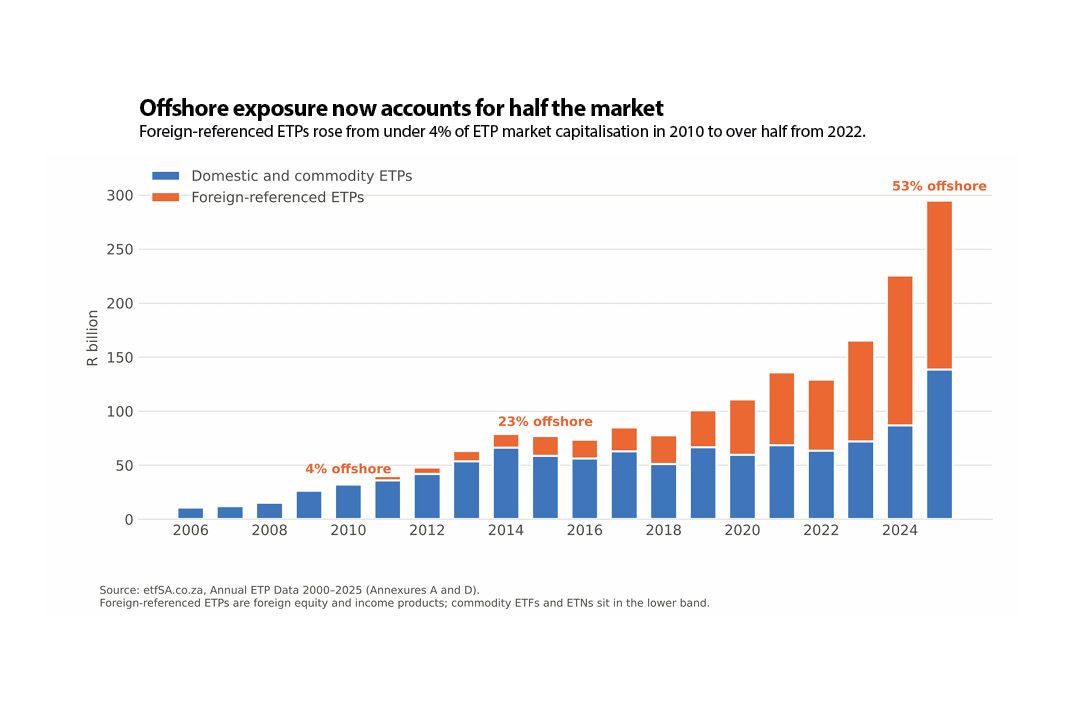
JSE-listed global feeder ETFs are rand-denominated and settle locally, so a client obtains developed or emerging market equity exposure without externalising funds, applying for tax clearance or using their single discretionary allowance.
Given that the South African equity market is a small fraction of global market capitalisation, this is a structural benefit rather than a convenience. While ZAR-denominated global feeder unit trust funds are available, they typically add another layer of fees to the investor experience.
5. Accessibility at the bottom end of the market
This advantage is easy to overlook from inside a practice serving affluent clients, but it is significant for the profession. An ETF has no minimum investment beyond the price of a single unit, and AMETFs carry no minimum either. A client can therefore invest in a properly diversified portfolio with a few hundred rand and add to it monthly.
For advisors, this changes who can be served economically. It makes it possible for you to onboard a client’s (adult) children, to run a tax-free savings account contribution for a young earner, and to build a relationship years before the assets justify a full financial planning process and commensurate fee.
It also gives clients somewhere sensible to place irregular capital inflows such as a bonus or small inheritance.
Again, this logic holds true for unit trusts, but the advantage of ETFs lies in the broad access via a single platform – the JSE. Not every LISP has the same range and so an advisor (and a client) arguably requires more complicated administration for reporting and implementation if they use unit trusts.
6. The evidence on relative performance
Prof. William Sharpe’s arithmetic of fund management clearly states why cost matters. Before costs, the return on the average actively managed rand invested in a market must equal the return on the average passively managed rand, because together they constitute the market. After costs, the average actively managed rand must therefore underperform.
This argument is based on averages, so it is possible that the outperformance of a specific manager may compensate for their higher fees in a specific time period, but this is very difficult to do consistently over long periods of time. Let’s look at the evidence.
SPIVA is the S&P Indices Versus Active, a research initiative and scorekeeper created by S&P Dow Jones Indices that measures the performance of actively managed funds against their index benchmarks. The SPIVA South Africa Year-End 2025 Scorecard makes uncomfortable reading for active management in most, though not all, categories.
The S&P South Africa 50 surged 46% in 2025 while South Africa Equity funds returned 35% on an asset-weighted basis; 80% of funds lagged the S&P South Africa Composite Capped over the year, rising to 89% over three years, 88% over five and 94% over 10.
Global equity managers fared somewhat better in 2025 than in 2024, with 66% underperforming the S&P World against 93% the prior year – but 92% underperformed over three years and almost 100% over 10 years. Diversified and aggregate bond funds recorded 78% underperformance in 2025 and 85% over 10 years.
Survivorship compounds the problem, and it is the part most often overlooked. Across all categories, 39% of funds did not survive the 10-year period. Among South Africa Equity funds specifically, merger and liquidation rates reached 17%, 28% and 51% over three, five and 10 years respectively.
A fund selection decision made today has roughly even odds of requiring a replacement decision within a decade – with the client’s capital gains tax and the advisor’s explanation both due at that point.
Now the glass-half-empty perspective…
Now to apply some critical analysis. Note that most of these critiques are based on the use of passive ETFs. As we point out elsewhere in this publication, this is not the full range available.
Active management does add value consistently in some situations
First, active management demonstrably earns its fee in some categories. The same SPIVA scorecard shows short-term bond managers beating the STeFI Composite convincingly: only 9% underperformed in 2025, with rates of 17%, 18% and 32% over three, five and 10 years.
Where a benchmark is structurally constrained or a market segment is less efficiently priced, the case for the use of low-cost, passive index trackers weakens a lot.
Second, tracking is always imperfect and locally this is more of a problem. South African research finds that JSE-listed ETFs exhibit tracking errors higher than those in developed markets, although broadly comparable to other emerging markets and that tracking error is higher during bearish market conditions – that is, precisely when clients are watching.
ETFs tracking international benchmarks tend to track less efficiently than domestic ones, owing to factors such as non-overlapping trading hours, dividend withholding tax treatment and exchange rate volatility.
Third, an index is not always well diversified. The JSE is highly concentrated, and a Top 40 tracker delivers that concentration exactly. Innovation in the ETF space has offset this to a large degree, but requires that advisors have a good understanding of the differences between the headline and the multiple index versions available.
So, what should you do?
It is important to recognise that the points made above against the ETFs do not undo the previous arguments for their use by advisors. They emphasise a more important point: ETFs are a very good default option, but they are not a universal answer to every situation.
The challenge facing the advisor is to know when and how to use an ETF.