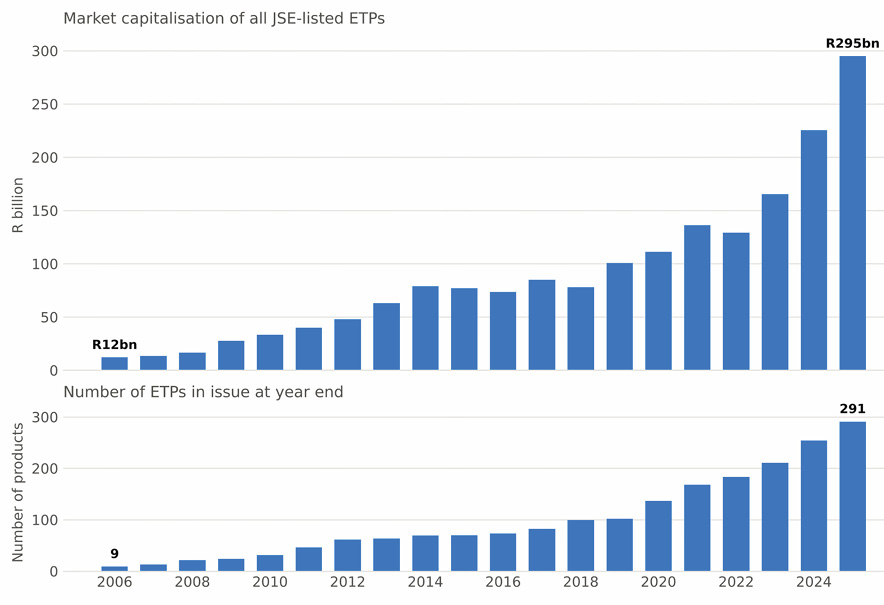
Domestic equity: the broad market
This is the historical starting point for the ETF evolution, and the one where the choice of index matters the most. Historically there was a choice of ETFs tracking the FTSE/JSE Top 40, All Share, SWIX (shareholder-weighted) and Capped SWIX indices. They all provided investors with access to the “South African equity market”, but closer examination shows that they describe very different versions of it. SWIX weights constituents by shares held on the South African register (not all the shares listed), materially reducing the dominance of large dual-listed rand-hedge counters.
Capped variants limit any single constituent’s weight. In a market as concentrated as the JSE, choosing between these can have a real effect (particularly on the risk of the portfolios as some are significantly more concentrated than others).
Since December 2025, the SWIX approach was absorbed into the standard indices so the choice of broad, market-based indices now includes the Top 40 and All Share indices although both are typically capped to prevent individual share exposures dominating the return/risk profile.
Domestic equity: sector and factor-specific ETFs
There has been significant innovation in this area of ETFs. Sector trackers cover resources, financials and industrials. More recently, “smart-beta”, or factor-based ETFs weight their share exposures by something other than market capitalisation.
The Satrix RAFI 40, for example, weights constituents by dividends, cash flow, sales and book value, while momentum, equal-weighted, dividend, quality and low-volatility variants are also available.
The year 2025 illustrated both the promise and the danger of these innovations: the Satrix RESI 10 was the best-performing equity ETF on the JSE, surging 142% on the back of the gold and platinum rally, while the Satrix RAFI 40 returned 54% against the FTSE/JSE Top 40’s 49% total return (ETFSA, 2026). Sector concentration will cut in both directions, however, and a 142% year is a reason for caution in a client conversation, not just enthusiasm!
Global equity: the feeder funds
This is a very useful category for South African financial planning. Global equity ETFs listed on the JSE are rand-denominated and bought through a local stockbroking account, which means a client obtains offshore market exposure without externalising funds or drawing on their foreign investment allowance.
The range covers MSCI World, the S&P 500, the Nasdaq 100, MSCI Emerging Markets and, since February 2026, MSCI Japan and the STOXX Europe 600 – the latter two listed with total expense ratios of 0.35% and 0.25% respectively. Satrix cut the TER on its flagship MSCI World ETF from 0.35% to 0.25% with effect from 1 October 2025.
Regional dispersion of returns in 2025 made the case for looking past the United States. In rand terms, the MSCI Emerging Markets Index returned 18.2% and the Sygnia Itrix Emerging Markets 50 ETF 26.5%, while the MSCI World managed 6.9% and the S&P 500 just 3.7%. The Eurozone returned 19.8% and the United Kingdom 17.3%.
Listed property
Both South African and global listed property ETFs are available. Local property ETFs enjoyed another strong year in 2025 and are up more than 250% from their March 2020 lows – a useful reminder of how an investor’s entry point determines their experience of an investment.
Fixed income
The local range covers government bonds (the GOVI family), inflation-linked bonds (ILBI), short-dated cash and money-market proxies, and corporate bonds. The FTSE/JSE All Bond Index returned 24% in 2025. Global bond exposure is available through feeder structures described above.
Commodities
Physically backed precious-metals products cover gold, platinum, palladium and rhodium. Each debenture is typically backed by a fraction of a troy ounce, with metal held as London Good Delivery bars at recognised custodians.
Management fees run at roughly 25 basis points for gold, 30 for platinum, 35 for palladium and 75 for rhodium. The year 2025 was a commodity year. The Absa NewGold ETF climbed 46% and remains the largest ETF on the JSE with a market capitalisation above R40-billion; the Absa NewGold-Platinum ETF rose 94% and rhodium 82%.
A reminder that these are not collective investment schemes. Bullion is not a listed security, so a physically backed fund cannot be registered under CISCA and is issued as debentures by a ring-fenced special purpose vehicle instead.
Two consequences follow for planning. They are not subject to CISCA’s diversification and spread requirements, so a single-metal ETF is exactly as undiversified as it sounds. And they cannot be held in a tax-free savings account, because the only permitted instruments in these accounts are ETFs classified as collective investment schemes.
Exchange-traded notes: similar, but not equivalent
As explained in the regulatory context, ETNs share the trading mechanics but not the legal protection of ETFs. They are unsecured debt of the issuer, so the client holds bank credit risk alongside the market exposure. The Absa NewWave Silver ETN returned 120% in 2025, which is precisely the sort of number that gets a product recommended without the possible pitfalls of this particular structure being appreciated.
Multi-asset and balanced
A newer and, for planners, significant development is the introduction of multi-asset ETFs. For example, the ETFSA Balanced Foundation Prescient AMETF conforms to both Regulation 28 of the Pension Funds Act and FSCA Board Notice 90, with an expected TER of approximately 0.52%, which is below a typical balanced unit trust. The ETFSA Oyster Global Balanced Prescient AMETF, listed in April 2026 under the ticker OYSTER, runs a globally diversified 75% growth and 25% fixed-income mandate aimed at a minimum seven-year horizon.
Note that these are all actively managed ETFs as they allow the managers the freedom to change their asset allocations – a key risk control lever for these managers. As always, the detail matters – an advisor must understand the mandate behind the AMETF and the basis for the decision-making around both the asset allocations and individual asset class implementations allowed by it.
Actively managed ETFs
This is the fastest-growing segment currently. At the moment, listings include products such as 27Four’s SA Large Cap, SA Multi-Factor, Global Multi-Factor and Global Shariah AMETFs; the Amplify Strategic Income Satrix Feeder AMETF (AMPSTI), investing in South African government and corporate bonds and money-market instruments; the Absa Cartesian Absolute Income product; and, from May 2026, the Anchor EasyETFs Aspirant Global Equity (AAGEET) and Aspirant SA Equity (AASAET) AMETFs.
Like all ETFs, AMETFs are regulated collective investment schemes under CISCA and subject to JSE Listings Requirements, so the investor protections are the same as for a unit trust. They may cost more than an index ETF but can be cheaper than an equivalent unit trust because of lower distribution and platform costs.
Shariah and sustainability
Shariah-compliant equity ETFs are available both locally and globally, and NewGold for example complies with Shariah law. A small number of ESG and climate-screened products are also listed.
An important thing to remember
Breadth is not the same as depth. Several thematic and sector ETFs are small, narrow and relatively young, and a fund that never gathers assets is a fund that may be closed.
Also, all funds in the same area of ETFs are not necessarily doing the same thing. Every advisor considering these products needs to do the same due diligence on their underlying mandate, focusing on the index design and implementation in the case of traditional ETFs and the risk limits allowed and the investment philosophies used by the underlying investment managers.
Doing one’s homework thoroughly becomes more important as choice increases.