
“Managers have been so focused on being fundamentally right about these mega-cap stocks that they have forgotten the job is to beat the index, not be correct.”
That blunt observation, made to us by a frustrated superannuation fund CIO, gets to the heart of a problem that has been building for years. The issue is not that fundamentals no longer matter. It is that fundamental conviction must now be expressed with far greater awareness of benchmark-relative risk.
For investors, this raises an important question. If concentration, volatility and changing market structure have altered the risks of active management, is the traditional high active risk approach still the most effective way to pursue outperformance?
A difficult decade for active managers
Over the decade to June 2026, less than 15% of active equity funds in a recent global study outperformed a comparable passive alternative. While many view this as evidence against active management, we believe it primarily reflects a market increasingly dominated by a small number of very large companies. 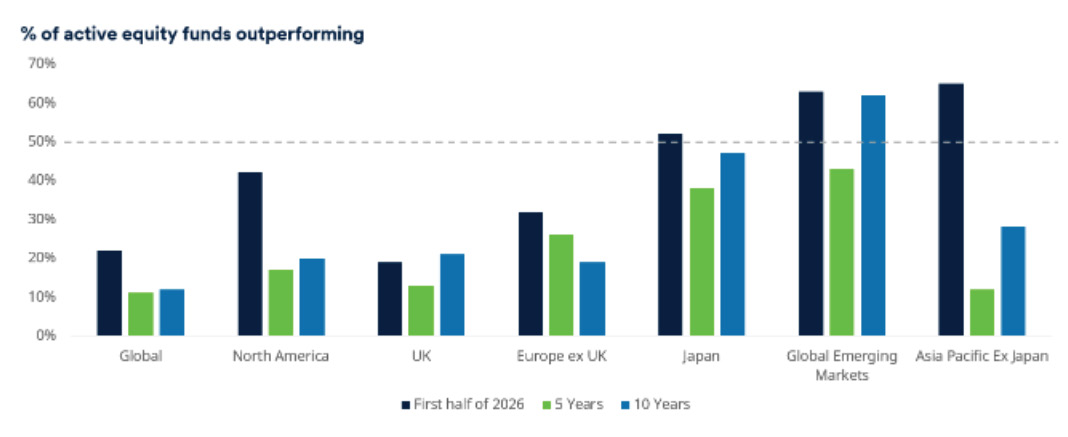
Source: AJ Bell https://www.ajbell.co.uk/news/are-active-funds-keeping-their-tracker-counterparts Data as at June 2026. The above shows the percentage of active funds, based on regional investment universe, outperforming the average passive index fund for the same region. Regions are based on IA sectors. Chart is provided for illustrative purposes.
Traditional active managers have tended to be underweight one or more of the largest benchmark constituents. Historically, this was often a modest expression of valuation discipline. Today, it can be one of the most significant drivers of relative performance.
The top ten stocks now account for roughly 37% of the S&P 500, with other major developed markets also becoming increasingly concentrated. When a handful of companies drive a disproportionate share of market returns, even successful stock selection elsewhere can struggle to offset a large underweight to one of those benchmark leaders.
% Weight of top 10 stocks in regional equity markets
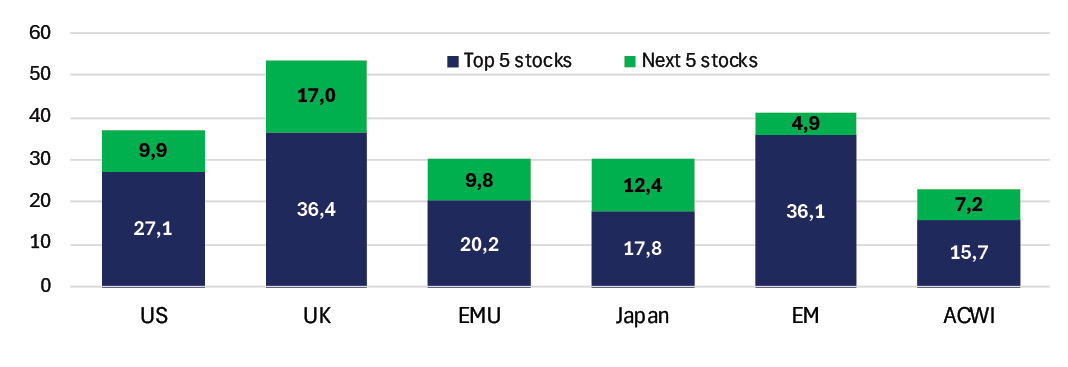
Source: MSCI, as at June 2026.
The challenge is particularly acute for concentrated managers. As benchmark concentration increases, there is progressively less weight elsewhere in the index to fund meaningful active positions. The result is that portfolios often become more dependent on a relatively small number of benchmark-relative views than many investors appreciate.
Concentration is only part of the story
Index concentration has been widely discussed for years. On its own, however, it is largely a static problem. What has changed is the way markets now trade around those concentrated weights.
Several structural shifts are amplifying benchmark risk.
First, market leadership has become increasingly narrow. Recent market returns have been driven by a relatively small number of companies, while a large proportion of stocks have lagged or declined. Missing one or two of the year’s biggest winners can therefore have an outsized impact on relative returns.
Second, speculative trading has surged. Options markets have expanded rapidly, particularly in short-dated contracts, with activity increasingly concentrated around the largest benchmark constituents. In many cases, trading volumes in options now rival or exceed activity in the underlying shares.
Third, flows have become faster, larger and more mechanical. ETFs, leveraged products, basket trading and passive strategies increasingly direct capital toward the same stocks and themes. These flows are often price-insensitive and can reinforce momentum regardless of underlying fundamentals.
Finally, volatility beneath the surface has increased. While headline index volatility has appeared relatively contained, single-stock volatility has risen markedly. The largest stocks in the market can now exhibit volatility profiles that historically belonged to much smaller companies.
Individually, each of these developments matter. Combined, they fundamentally change how active risk behaves.
When being right isn’t enough
These market conditions create a challenge for high-conviction investors.
Historically, a manager who identified an overvalued company could express that view through a meaningful underweight position while expecting fundamentals to prevail over time. Today, that same position can become one of the largest sources of tracking error in a portfolio.
The risk is no longer simply being wrong. A manager can be right on the company, but wrong on the theme. A manager can be right on valuation, but wrong on timing. A manager can be right on fundamentals, but still see relative returns overwhelmed by benchmark concentration, ETF flows or speculative trading activity.
The AI investment theme provides a useful example. Markets have broadly rewarded AI-related infrastructure exposure, including semiconductors, memory, data centres and power. Yet performance within the theme has varied dramatically. Identifying the right theme has not always been sufficient. Investors have also needed to understand how that theme was being traded, where crowding existed and which companies had the most durable earnings support.
In today’s market, stocks are often traded as part of thematic baskets before fundamentals have an opportunity to differentiate winners from losers. That creates a more challenging environment for concentrated portfolios built around a limited number of high-conviction views.
The view of active risk has changed
This is where many investors are reassessing active risk.
The question is not whether active management remains valuable. It is whether the same amount of active risk that investors accepted a decade ago is still being adequately rewarded.
Larger benchmark weights mean active positions are bigger bets. Higher stock-specific volatility means those bets move further. Faster, more thematic trading means those moves can occur more quickly and with less connection to company fundamentals.
As a result, conviction alone is no longer enough. Conviction needs to be sized appropriately for the market environment in which it is being expressed.
That means understanding not only the underlying company, but also its benchmark weight, the volatility of the stock, the degree of crowding in the theme and the market flows that may amplify price movements.
Why lower active risk is attracting attention
Against this backdrop, based on our research, it is notable that some of the managers who have delivered the most consistent results have not been those operating at the highest end of the active risk spectrum, nor have they been those wed to a single style.
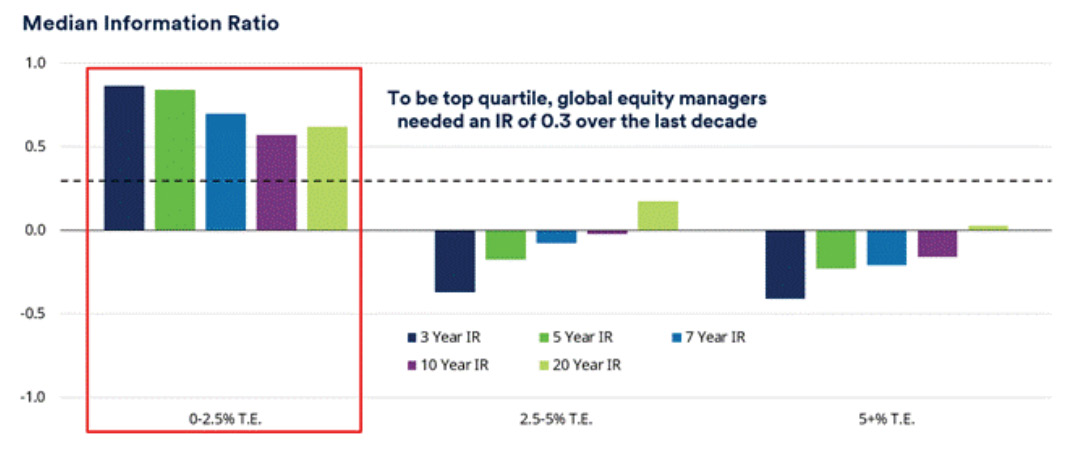
Source: eVestment. Schroders. Gross of fee returns as of March 2026. Buckets created using 5yr Tracking Errors. Universe names in full: eVestment Global Enhanced Equity, eVestment Global All Cap Core Equity, eVestment Global Large Cap Core Equity, eVestment Global All Cap Growth Equity, eVestment Global Large Cap Growth Equity, eVestment Global All Cap Value Equity, eVestment Global Large Cap Value Equity. Funds without any relevant data are omitted. A number funds have been removed, including Passive/Sector Specific/Thematic and those not managed against MSCI World or MSCI ACWI and its variations.
Instead, managers with broader portfolios, tighter risk controls and lower tracking error have generally been more resilient through an environment characterised by rising concentration and heightened stock-specific volatility.
Their advantage has not necessarily been superior forecasting. Rather, it has been their focus on relative risk and the ability to spread bets across a wider opportunity set and avoid becoming overly dependent on a small number of benchmark-relative positions.
Active management must evolve
The managers who have navigated this environment most successfully are not necessarily those making the boldest calls. They are generally those who carefully manage risks relative to the index.
Today’s benchmark is no longer a neutral measuring stick. It is a concentrated exposure to a relatively small number of large, volatile and increasingly flow-sensitive stocks. Investors still expect active managers to outperform that benchmark, but doing so requires a different approach to risk than it did a decade ago.
As we see it, long-term investment success still depends on conviction, valuation discipline and a clear understanding of business fundamentals. But it also depends on recognising that risk management is no longer simply a constraint on alpha.
Increasingly, it is the mechanism through which alpha becomes repeatable.

Disclaimers:
Important Information
For professional investors only. The material is not suitable for retail clients. We define “Professional Investors” as those who have the appropriate expertise and knowledge e.g. asset managers, distributors and financial intermediaries.
Investment involves risk.
This information is a marketing communication. The information contained herein is believed to be reliable. Where third-party data is referenced, it remains subject to the rights of the respective provider and must not be reproduced or used without prior consent.
Any data has been sourced by us and is provided without any warranties of any kind. It should be independently verified before further publication or use. Third party data is owned or licenced by the data provider and may not be reproduced, extracted or used for any other purpose without the data provider’s consent. Neither we, nor the data provider, will have any liability in connection with the third party data.
The material is not intended to provide, and should not be relied on for accounting, legal or tax advice, or investment recommendations. Reliance should not be placed on any views or information in the material when taking individual investment and/or strategic decisions.
Any references to securities, sectors, regions and/or countries are for illustrative purposes only.
Past performance is not a guide to future performance and may not be repeated. The value of investments and the income from them may go down as well as up and investors may not get back the amounts originally invested. Exchange rate changes may cause the value of any investments to rise or fall. Schroders has expressed its own views and opinions in this document, and these may change.
This document may contain “forward-looking” information, such as forecasts or projections. Any forecasts stated in this document are not guaranteed and are provided for information purposes only.
Schroders will be a data controller in respect of your personal data. For information on how Schroders might process your personal data, please view our Privacy Policy available at https://www.schroders.com/en-za/za/intermediary/footer/privacy-policy/ or on request should you not have access to this webpage.
For your security, communications may be recorded or monitored.
Issued in October 2026 by Schroders Investment Management Ltd registration number: 01893220 (Incorporated in England and Wales) which is authorised and regulated in the UK by the Financial Conduct Authority and an authorised financial services provider in South Africa FSP No: 48998.