
85% of global investors anticipate increased volatility in the 12 months ahead, according to the latest release of Schroders’ Global Investor Insights Survey. The annual survey, which this year questioned more than 1,000 investors around the world in the period following the outbreak of war in Iran, provides a temperature-check on investors’ concerns and intentions.
Volatility as the new norm, with longer-term drivers
While the vast majority predict higher volatility in the coming year, they attribute its cause to longer-term drivers, with top three geopolitical risks cited as conflict in the Middle East (69%), uncertainty in US foreign policy and global leadership (67%) and threats to energy security (60%). The latter is a key concern: when asked to cite upcoming risks likely to impact portfolios, the single risk most mentioned was “commodity and energy price shocks” (26%).

While South African and Middle Eastern investors appear less concerned about commodity and energy prices shocks (10%), they are far more worried about currency volatility including dollar weakness (23% versus the global average of 10%).
Knock-ons for portfolio construction: going global for diversification and opportunity
Given expectations of volatility, investors are becoming both more defensive and opportunistic. When asked how they planned to respond, investors said they would seek buying opportunities (global average 49%, South Africa and Middle East average 43%), increase geographic diversification outside the US (global average 47%, South Africa and Middle East average 60%) and move to defensive, cash-like assets (global average 40%, South Africa and Middle East average 60%).
The three asset classes investors see as offering greatest portfolio benefit are global equities (37%), small or mid-cap equities (32%) and real assets such as property or infrastructure (28%).
Figure 1. Which of the following portfolio changes are you making or planning to make?
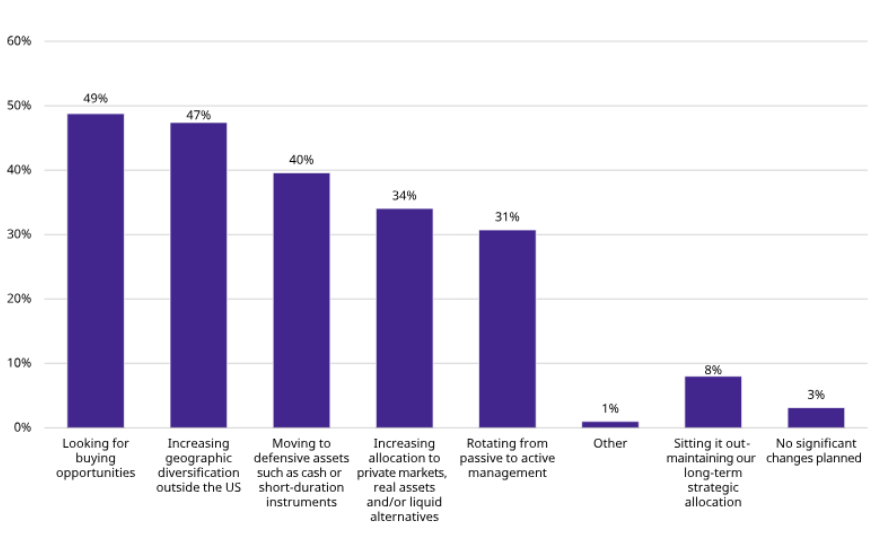
Source: Schroders Global Investor Insights Survey 2026. Respondents asked to select up to three choices.
Portfolio objectives have undergone a similar shift. The top three objectives, in the current environment, are diversification (global average 84%, South Africa and Middle East average 93%), downside protection or capital preservation (global average 83%, South Africa and Middle East average 73%), and only then capital growth (global average 61%, South Africa and Middle East average 53%).
The switch toward active management
Actively managed investments, rather than passive strategies that mirror market composition, are prominent among investors’ identified solutions. As shown in Figure 1, almost a third (31%) plan to move assets from passive to active management.
There is widespread conviction that active approaches will bring benefits in today’s markets. 85% of those surveyed say they are “somewhat or very” confident that active management will help meet their objectives. South African and Middle Eastern investors display even more confidence than the global average at 97%.
According to Johanna Kyrklund, Group Chief Investment Officer at Schroders: “Investors are reshaping portfolios to put diversification and resilience front and centre, while also juggling geopolitical risk. It is telling that in these circumstances, an overwhelming majority of investors expressed confidence that active managers can help achieve those objectives in the next 12 to 18 months.
“The ability to be selective, manage risk and respond dynamically to fast-moving market conditions is our active edge to navigating these choppier waters.”
Limiting concentration risk with active allocation
The fact that markets are at or near historic highs – set against a backdrop of multiple perceived risks and increased volatility – may explain why active approaches are currently so attractive. Investors point to both the defensive qualities of active management and the potential to make gains from market mis-pricing.
When asked to specify the characteristics of active management that gave them confidence, investors’ top three choices were the ability to capture outperformance (61%); navigate uncertainty (53%) and manage down the high levels of concentration risk in equity markets (48%).
The latter has been a concern for several years, and is surfacing again as appetite for AI exposure drives up the prices of public companies already highly dominant within indices. Currently, for example, US stocks have a weighting of over 70% in the MSCI World Index. And within the US S&P500 Index there is significant further concentration: the ten largest S&P500 stocks account for almost 40% of the index. This concentration has risen steadily over the past decade, having been below 20% in 2015-16*.
The AI paradox: opportunity and disruption
Artificial intelligence introduces an additional layer of complexity to the macro outlook. Investors are ambivalent about AI, but it is squarely on their radars. When asked to rank three trends most likely to impact portfolios in the coming 12 months, AI-driven disruption was the second risk (behind commodity and energy price shocks).
Figure 2: Which of the following do you expect AI to impact, positively and/or negatively?
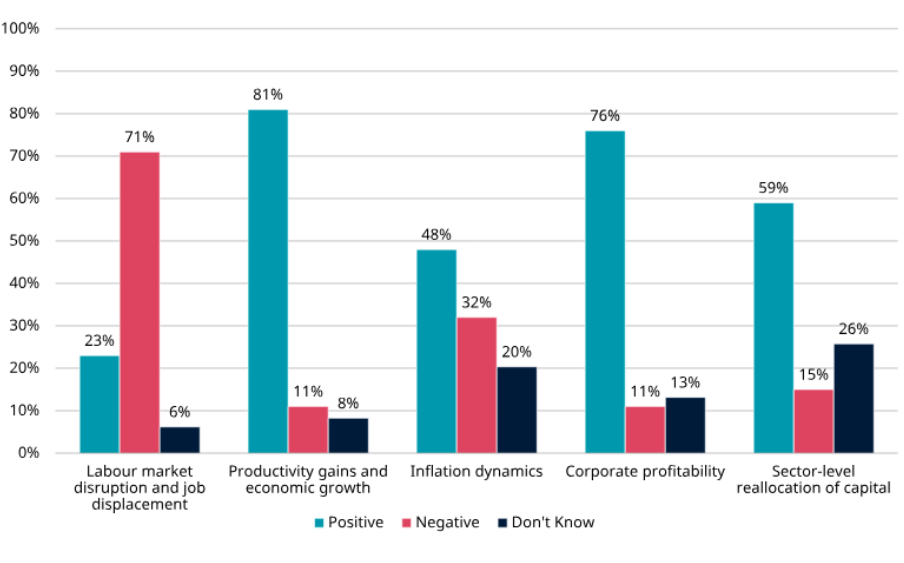
Source: Schroders Global Investor Insights Survey 2026.
Investors expect AI to have broadly positive effects on:
- Productivity and economic growth
- Corporate profitability
- Capital allocation across sectors
But they are wary of AI’s potential to disrupt labour markets and displace jobs. Interestingly, there are mixed views about AI’s potential impact on inflation. Many commentators have pointed to AI as a means of improving productivity and dampening inflation, and 48% of respondents see a likely positive effect of AI limiting inflation through increased productivity.
However 32% anticipate a negative inflation dynamic, perhaps because they see AI’s huge requirement for associated energy and other investment as potentially inflationary.
Find out more about investors’ current concerns and how they are responding: visit Schroders Global Investor Insight Survey 2026
*Source: S&P, Schroders. As at 30 April 2026.
Source: Schroders
Disclaimers:
Important Information
For professional investors only. The material is not suitable for retail clients. We define “Professional Investors” as those who have the appropriate expertise and knowledge e.g. asset managers, distributors and financial intermediaries.
Investment involves risk.
This information is a marketing communication. The information contained herein is believed to be reliable. Where third-party data is referenced, it remains subject to the rights of the respective provider and must not be reproduced or used without prior consent.
Any data has been sourced by us and is provided without any warranties of any kind. It should be independently verified before further publication or use. Third party data is owned or licenced by the data provider and may not be reproduced, extracted or used for any other purpose without the data provider’s consent. Neither we, nor the data provider, will have any liability in connection with the third party data.
The material is not intended to provide, and should not be relied on for accounting, legal or tax advice, or investment recommendations. Reliance should not be placed on any views or information in the material when taking individual investment and/or strategic decisions.
Any references to securities, sectors, regions and/or countries are for illustrative purposes only.
Past performance is not a guide to future performance and may not be repeated. The value of investments and the income from them may go down as well as up and investors may not get back the amounts originally invested. Exchange rate changes may cause the value of any investments to rise or fall. Schroders has expressed its own views and opinions in this document, and these may change.
This document may contain “forward-looking” information, such as forecasts or projections. Any forecasts stated in this document are not guaranteed and are provided for information purposes only.
Schroders will be a data controller in respect of your personal data. For information on how Schroders might process your personal data, please view our Privacy Policy available at https://www.schroders.com/en-za/za/intermediary/footer/privacy-policy/ or on request should you not have access to this webpage.
For your security, communications may be recorded or monitored.