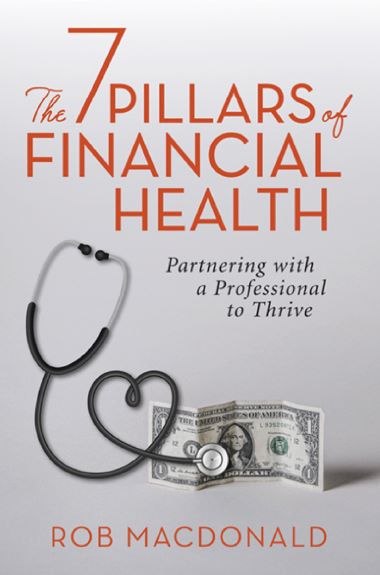
I recently ran a series of workshops on courage with financial planners, and it was heartening to see how the topic resonated so strongly with them. I believe courage is a core skill for financial planners to develop and is one of seven key skills for clients and financial planners that I include in my book The 7 Pillars of Financial Health.
What makes courage so important for effective financial planning? It is easy to see the benefit of courage in physical situations. I enjoy riding a mountain bike, but I’m fearful when navigating any route remotely treacherous. A little more courage would help me enjoy those rides more, and more importantly, would help me be more skilful when navigating challenging obstacles. I can’t get my head around the mantra that “speed is your friend” on a mountain bike. To appease my lack of courage, I now ride mainly on gravel roads, for which I have enough courage to enjoy myself. It’s comforting knowing I don’t have to take too many big risks.
This brings me to the role of courage in an intra- and interpersonal sense, which are very different from physical courage. We probably all know what courage feels like inside us, but because it’s intra-personal, it’s hidden from others. Similarly, with interpersonal courage, it’s not always easy to see whether it’s being demonstrated or not. It’s much easier to see courage being demonstrated on a mountain bike when the rider races down a hair-raising single-track trail. So in an intra- and interpersonal sense, we may know we’re being courageous but this won’t necessarily be clear to others. Teagan Philips, a South African cyclist, cartoonist and adventurer, in a TED Talk in 2017, coined physical courage as “sexy courage”; and intra and interpersonal courage as “unsexy courage”. Looked at this way, it is clear which courage is more appealing to act on.
Courage is extremely important for a financial planner, but what makes it so important if their clients are unlikely to know the difference? A risk is that financial planners may take the path of least resistance with their clients. Clients often don’t know what they want, what they need or what is good for them. It’s a bit like someone going to see a doctor and not realising that eating lots of sugar is not good for them. The doctor tells the patient directly.
Telling someone that they are eating too much sugar is arguably easy. For a doctor to tell us that we have a terminal illness may not be as easy. But the doctor is bound by their Hippocratic oath to tell us the way things are, whether this is easy or difficult.
Financial planning, however, is more nuanced. Our poor spending habits may not be life-threatening, not in the short-term anyway.
I often hear financial planners talk of clients who earn well but spend even better. The path of least resistance is not to challenge the client about this behaviour. I’ve seen financial planners who don’t want to “rock the boat” with clients. The potential risk to the relationship of challenging the client is too much for them. They would rather keep the client who may be valuable to them in other ways. They may have a large asset base, be a good source of referrals, or be someone with whom they have a warm relationship.
But in such a scenario, courage is absent, the courage to focus on what is really in the client’s best interests despite the risk this may pose to the client, the relationship and potentially to the financial planner’s income.
Acting in the client’s best interests requires courage, particularly when their behaviour is in the spotlight. Spending too much may be a symptom of something deeper. A troubled marriage, an unsatisfying career or something even deeper that requires clinical intervention.
Simply telling someone they are spending too much is unlikely to have an impact. The challenge for the financial planner is to find a way for the spendthrift client to acknowledge their behaviour and own the need to change it. Easier said than done. How can courage help in a situation like this?
A financial planner recently asked me for some observations about a client scenario that ultimately led to losing the client. In one sense the financial planner had shown great courage. He had addressed the client’s excessive spending. I asked how he had approached it.
The client had said she wanted more “fiscal discipline”. The financial planner immediately thought of the solution, a budget. The client liked the idea. The financial planner drew up a budget for the client. Yet nothing changed. In fact, things deteriorated to the extent that the client fired the financial planner because he had not made any difference in the client’s life. Despite showing courage by attempting to help the client rein in their poor “fiscal discipline”, the financial advisor failed both the client and himself.
“Sexy” courage is for those who are happy to risk life and limb on their bicycles.
What went wrong? The client clearly did not take ownership of the budget the planner had drawn up. The financial planner had obtained the client’s input: she had provided all the numbers. But whose budget was it? This was not a collaborative approach.
This was the client delegating a task to the financial planner which ultimately the client needed to own and live by. It was much easier for her to suggest that the financial planner hadn’t helped, had done nothing to improve her life. The client was still sitting with the original problem of a lack of “fiscal discipline”. And this is where the financial planner would have been best advised to begin.
What exactly did the client mean by “fiscal discipline”? The financial planner had failed to unpack this with her. What was the spending pattern in the client’s life? What was behind this pattern?
In my conversation with the financial planner, he acknowledged that he hadn’t explored any of this. He was curious about what was driving the client’s behaviour but didn’t have the courage to ask the question. So often a financial planner chooses not to go there because they fear what they may find out. This is the courage financial planners need if they are truly to serve their clients.
Drawing up a budget is easy. But getting to the bottom of what drives a client’s self-sabotaging behaviour requires courage and of course well-developed interpersonal skills. But without courage, the most well-honed skills will not be enough.
As Maya Angelou says, “Courage is the most important of all the virtues, because without courage you cannot practise any other virtue consistently.”
And for financial planners and their clients, it’s the “unsexy” courage that is the virtue that will serve both best, “sexy” courage is for those who are happy to risk life and limb on their bicycles.
| The 7 Pillars of Financial Health Based on insights gleaned from coaching and consulting with hundreds of financial and investment advisors over a career spanning 25 years, Rob Macdonald, Fundhouse, has recently published a book The 7 Pillars of Financial Health. Macdonald outlines why we need to radically rethink how we approach money in this compelling read, which is highly recommended for advisors who want to remain relevant in their professions. Similarly, it contains practical information that clients could use in the process of dealing with investment concerns. As Warren Ingram writes in the foreword, The 7 Pillars of Financial Health is not only aimed at professional planners: “Whether you’re a seasoned investor, a young professional just starting out, or simply an individual seeking financial well-being, this book will revolutionise your understanding of money and its role in shaping a fulfilling life.” Macdonald suggests that money ranks as a leading source of relational conflict and household stress in surveys worldwide despite the abundance of information and technology to help us manage it. In the introduction, he says that we go wrong by failing to recognise how completely interconnected and interdependent our lives and our money are. Macdonald uses the analogy of our physical health. We all know what to do to be physically healthy – eat healthily, exercise regularly, get enough sleep and limit our stress levels. But we struggle to do this because we are human. We are tempted by chocolate cake, delicious wine and the fact that Netflix is much more fun than going to the gym. He says, “The foibles of being human are summed up by the quip that ‘we spend our health to gain our wealth then spend our wealth to regain our health.” To overcome the challenges of being human while developing financial health, he enlarges seven skills that we need to work on throughout our lives. |