
2026 is the year Blue Chip celebrates its 100th edition, when Artemis II completed the first crewed spaceflight beyond low-Earth orbit since Apollo 17 in 1972 and the 40th anniversary of the Challenger space shuttle disaster, when the craft disintegrated 73 seconds after launch. These are landmark events and, I believe, they are connected.
The success of Artemis II raises an uncomfortable question: if we can achieve so much in space, why in the 21st century can we still not live more peacefully with our neighbours on Earth? It is a relevant question considering events in Ukraine, Israel, Iran and elsewhere. The deeper challenge may be that we still do not know how to speak to those who differ from us, whether by race, religion, gender or culture. You may well ask, what has this got to do with Blue Chip and the Challenger tragedy?
As Blue Chip is a publication for professional financial planners, it seems fitting to focus on a topic that is central to effective financial planning. Research repeatedly shows that a client’s experience is shaped less by the technical sophistication of the advice, the quality of the products or funds or even the cost of the service, than by the quality of communication.
That is not surprising. The effectiveness of advice and the suitability of funds or products can usually be judged only over years, often decades. Financial outcomes are inherently uncertain. We do not know when we will die, so a life policy may or may not pay out. Markets are volatile.
Clients do not know exactly when they will need to draw on investments or what those investments will be worth at that point. Divorce, retrenchment, a new career, a new marriage, a death in the family, the arrival of a child: life is full of transitions, many of them unpredictable. Yet human beings are wired for certainty and often make poor decisions when that certainty disappears.
One of the most valuable forms of certainty a financial planner can offer is clear communication. Consistent, transparent, relevant and jargon-free communication becomes a guardrail when the uncertainties of life and markets flare up. And perhaps the most powerful form of communication a planner can have with a client is conversation.
In the hybrid world we now inhabit, that may happen virtually or in person, but it remains human to human. As AI increasingly encroaches on territory traditionally occupied by advisors, there is some encouraging research from Jump, a US-based AI platform built for financial planners.
The quality of client conversations
For its 2026 Financial Advisor Insights Report, Jump analysed about 12 000 anonymised advisor-client meeting transcripts captured over a year. The report highlighted interesting data about conversation topics and recommendations, but probably its most impactful finding concerned client sentiment: the perceived emotional state a client appears to be in at a certain point during a conversation.
In quantifying sentiment, Jump analyses statements clients make during meetings that express either positive emotions, such as confidence and clarity, or negative ones, such as anxiety, uncertainty and confusion. From these it calculates a Client Sentiment Index on a scale from one to 10. That score can then be compared with factors such as the topics under discussion, events in the client’s life and changes over time, from one meeting to the next or from the beginning to the end of a meeting.
Jump found that client sentiment generally improves over the course of a meeting with an advisor. On average, sentiment rose by about one point on Jump’s 10-point scale between the beginning and end of a meeting. That remained true even when overall client sentiment dipped during periods of market volatility and economic uncertainty.
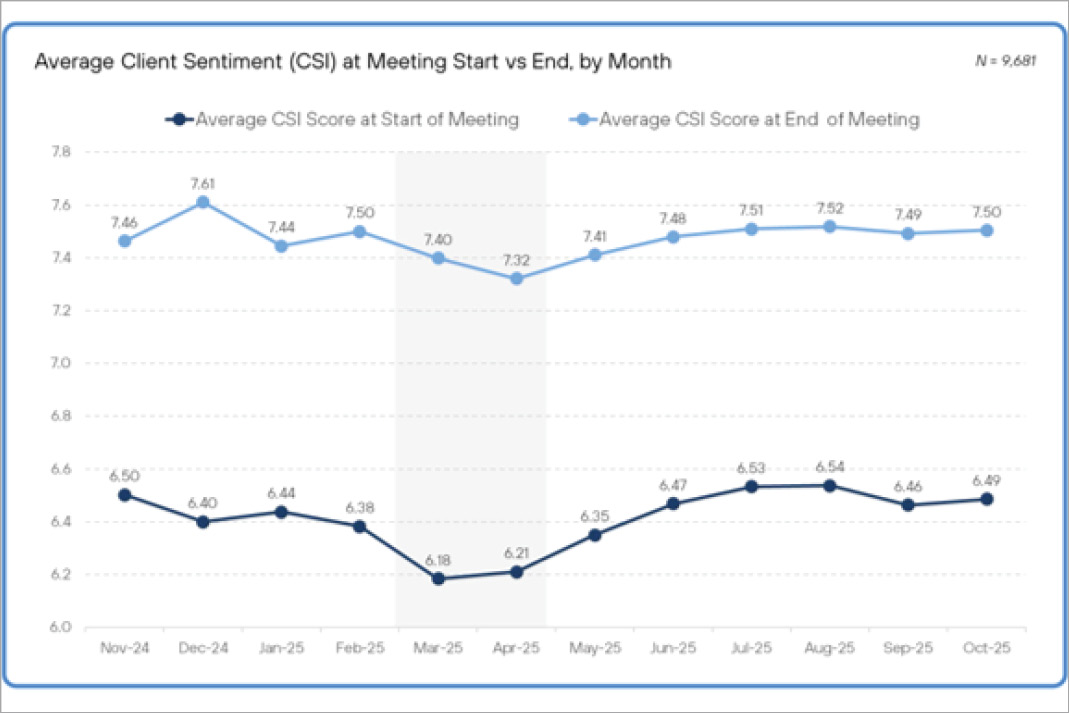
Source: Jump, 2026 Financial Advisors Insight Report. Sentiment, Behaviour and Outcomes
Jump identified four factors that contributed to improved client sentiment during a client meeting:
- The advisor’s talk time as a percentage of the total conversation during the meeting. Advisors who spoke less than clients during meetings, saw the highest increases in
client sentiment. - The number of open-ended questions asked. Questions that invite clients to expand on their perspective increase the client’s share of talk time and create more space for reflection.
- The number of empathetic statements made by the advisor. These are statements that show the advisor can show both cognitive and emotional empathy by making statements like, “that must have been very difficult for you”.
- The number of emotional check-ins performed by the advisor. These prompts invite the client to share what they are feeling in the moment, such as “how does that make you feel?”
Jump’s “Advisor Emotional Intelligence Score” is a single metric that combines these four elements. It then grouped financial advisors into five ranks based on that score and compared how much client sentiment improved across those groups. While advisors in every rank improved sentiment, those in the highest rank achieved almost twice as much improvement on average as those in the lowest.
It is also notable that advisors with higher emotional-intelligence scores tended to begin meetings with clients whose sentiment was already higher. That suggests there may be something about working with emotionally aware, empathetic advisors that improves a client’s emotional state not only during a meeting, but between meetings too.
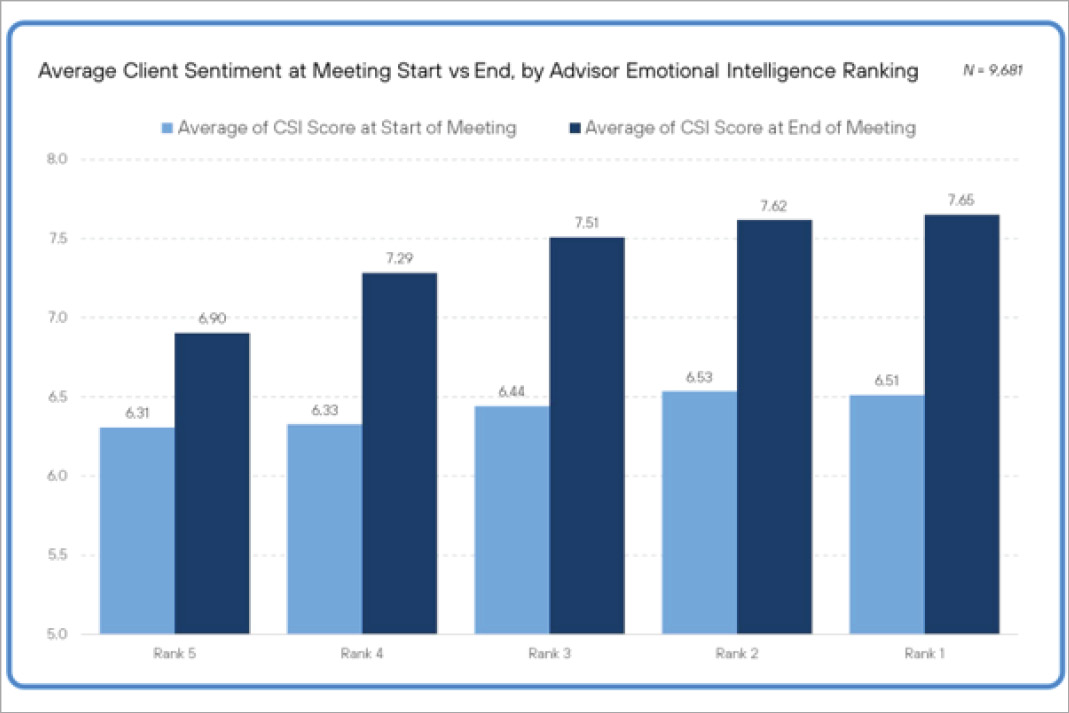
Source: Jump, 2026 Financial Advisors Insight Report. Sentiment, Behaviour and Outcomes
The essence of Jump’s research is simple: how a financial planner conducts a conversation matters. It also suggests that AI can help advisors improve not only efficiency and productivity, but the human side of their work. Used well, AI provides feedback on client sentiment, engagement and conversation quality. In that sense, it can help human advisors become better at using conversation, still the core form of communication with clients.
I often argue that being a skilled human will be the enduring superpower of financial advisors. But those skills do not develop by accident, and when they are absent, the consequences can be severe. This brings us back to the Challenger disaster which shows that the importance of skilled conversations matters beyond advisor-client meetings.
The Challenger disaster
Most accounts of the Challenger disaster begin with a technical failure involving the O-rings (the seals in the joints of the shuttle’s solid rocket boosters). Their function was to stop extremely hot, high-pressure gases from escaping during ignition and liftoff.
Because the boosters were built in separate cylindrical segments, the joints between them had to be sealed by two synthetic-rubber O-rings. When the fuel ignited, pressure was meant to force the primary O-ring into place and create a tight seal.
On the morning of launch, record-low temperatures of about -2°C made the rubber stiff and less elastic. As the metal joints flexed during ignition, the O-rings failed to seal the gap in time. Hot gases escaped, burned through key structures and led to the shuttle’s destruction.
But the deeper cause was not purely technical. Multiple investigations, including the Presidential Commission on the Space Shuttle Challenger Accident, concluded that a breakdown in communication between engineers and managers was a principal reason for the disaster.
Before the launch, engineers at Morton Thiokol, the shuttle contractor, had already noted O-ring problems in seven of the previous 24 shuttle launches. They linked those problems to low temperatures and, because the forecast for launch day was so cold, recommended to their superiors and to NASA that the shuttle should not be launched.
Management, however, was focused on satisfying NASA and asked engineers to prove that it was unsafe to launch, rather than applying a safety-first principle. In hindsight, if the data from the 17 trouble-free launches had been analysed alongside the seven problematic ones, the relationship between temperature and O-ring failure would have been clearer.
Instead, the discussions became debates to be won or lost, not dialogues aimed at reaching shared understanding. Selective listening, filtered bad news, differing interpretations of the same data and technical jargon that obscured the urgency of the warnings all contributed to a management decision to launch rather than an ethical decision to abort.
Why conversation still matters in a digital age
The lesson is that we ignore communication, and especially conversation, at our peril. Conversation is humanity’s oldest technology. It helps us build shared meaning, test assumptions and drive innovation. In the digital age it has been extended by smartphones, video calls, messaging platforms and, more recently, large language models that let people interact with computers through natural language rather than complex coding.
Yet research suggests that face-to-face exchanges still generate the highest levels of trust and engagement, and the most positive emotional responses. The oldest communication technology we possess remains highly relevant. But to use it well, we need intention, skill and structure if we are to serve clients effectively and engage one another more wisely as neighbours on Earth.
If we regard conversation as a technology, rather than something that just happens “naturally”, we can apply three key principles to improve it:
1. Intention matters. Not all conversations are equal. As the graphic of the Conversation Continuum shows, we can have a debate, where there is a winner or loser, as happened in the Challenger communication. Or we can have a dialogue, where the aim is to create new shared meaning. Asking “What is the purpose of this conversation?” before, during and even after the exchange helps keep it on track.
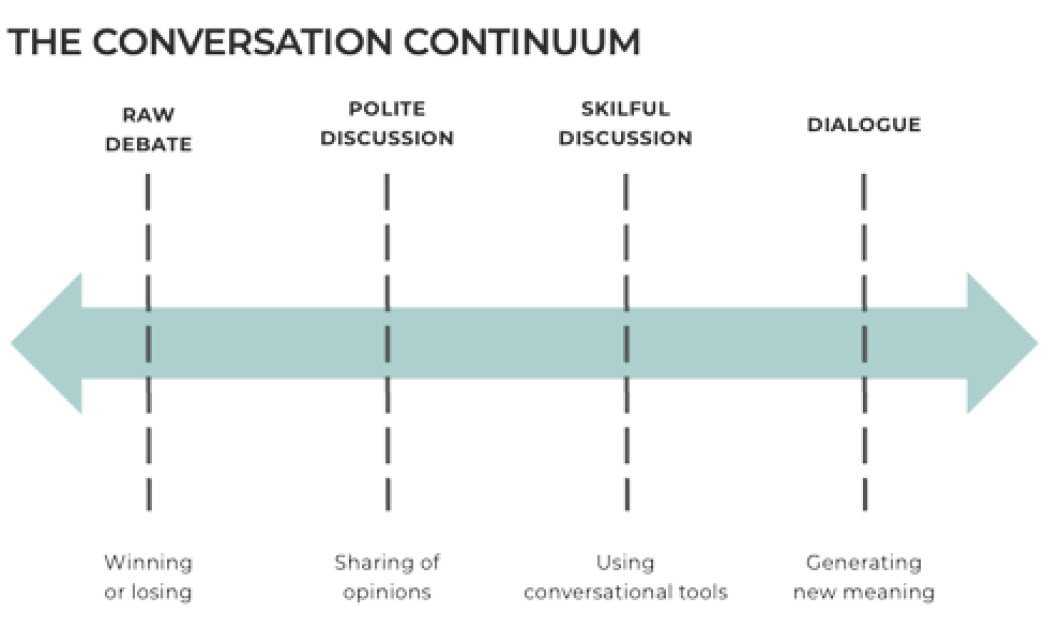
Source: R Macdonald, The 7 Pillars of Financial Health – Partnering with a Professional to Survive
2. Skill matters. No matter the purpose, skill influences the outcome. Winning a debate requires persuasive speaking and competitive listening. Achieving dialogue, by contrast, requires skill in speaking clearly, asking questions that open the conversation and listening for understanding.
Dialogue is collaborative rather than competitive, and this is ideally the kind of conversation a financial planner has with a client. The Native American “talking stick” offers a useful metaphor here: when groups gathered for dialogue, only the person holding the “talking stick” could speak, and each contribution had to build on what came before, keeping the group focused on shared understanding.
3. Structure matters. Productive conversations often unfold in stages. When we recognise the kind of conversation we are in, we can guide it more effectively towards a sound outcome. For example, in practice, I believe there are three distinct conversations an advisor can have with a client, and ideally, they take place in the following order:
i. Conversation for perspective. Here, the aim is to help the client clarify their own view of the issue or dilemma they face. How do they feel about what they are telling you? What is their relationship with the issue? Helping the client clarify their perspective inevitably helps the advisor understand it too. In the Challenger case, where a shared perspective on the O-rings was missing, this type of conversation would have been invaluable.
ii. Conversation for possibility. Once a client has a clearer perspective on their issue or dilemma, they can explore possibilities to resolve it, ideally generating them for themselves. In the Challenger case, one possibility might have been to examine more closely the O-ring performance in the 17 launches that did not have problems. This never came up. If it had come up, post-disaster investigations suggest that both engineers and management would have gained the insight that there was a 99% probability of disaster.
iii. Conversation for position. This final conversation leads to a position or decision. The more time spent in the conversations for perspective and possibility, the greater the chance of arriving at an optimal position. Conversations do not always unfold in a straight line, but when you know where you are in the process, you can guide the discussion more effectively. For example, a client may want to take a decision while not having explored all possibilities. Pausing and revisiting those possibilities can be a powerful way to stress-test the client’s position.
In many client relationships, the conversation for position arrives too quickly, before enough time has been spent on perspective and possibility. Being conscious of the different types of conversations one can have with a client helps lay the foundation for better outcomes from the conversation.
Taken together, Blue Chip’s centenary edition, the success of Artemis II, the lessons of the Challenger and the realities of advisor-client meetings all point to the same conclusion: outcomes are shaped not only by technical expertise, but by the quality of human conversation. For financial planners, that means conversation is not just a way of connecting with a client and getting to know them. It is a core professional capability, and perhaps the most powerful technology we still possess.
About ROB MACDONALD | Rob Macdonald has held several senior positions in the investment industry. He is an independent consultant and coach who also develops and facilitates training programmes in behavioural coaching and practice management. Before joining the financial services industry, Macdonald was MBA director at the UCT Graduate School of Business. He is the author of the book The 7 Pillars of Financial Health and is co-author of the books Rethinking Leadership and Frontiers in Financial Psychology. Macdonald has a Master’s degree in Management Studies from Oxford University and is a CFP® Professional.