It is amazing how difficult we professional investors can make investing money sound. The more jargon and codes, the more “sophisticated” an idea becomes – even when the underlying concept is quite simple.
The latest example is the global excitement around the so-called Total Portfolio Approach (TPA). If you’ve read recent international investment media, you’ve probably seen big names like California Public Employees’ Retirement System (CalPERS), Canada Pension Plan (CPP) and New Zealand Super Fund referenced as pioneers of TPA. Certain consultants claim that this approach to investing can add between 0.5% and 1.8% a year in extra returns.
What does all this mean for us in South Africa? Should we as financial advisors be excited, sceptical or both?
Let’s start by explaining the Total Portfolio Approach in simple terms. TPA seeks to keep the focus on the entire portfolio, the roles each investment plays within the portfolio and the results delivered by the entire portfolio. If you are thinking, isn’t that what everyone is doing? Sadly, the answer is no.
Many large institutional investors focus more on governance and have lost sight of the portfolio. For many large plans a Board of Trustees decides on a Strategic Asset Allocation (SAA) and acceptable ranges for each asset class within the SAA. CIOs then chop the SAA into asset classes and assign staff to focus on a specific asset class with the goal of beating the benchmark for that asset class.
The thinking is that if each team is allocated capital roughly in line with the SAA and each team outperforms their asset class benchmark then the overall portfolio will outperform the SAA. The problem with this non-TPA approach is that almost no-one is thinking about how the entire portfolio is coming together and how the decisions of one team impact the portfolio and should impact decisions made by other teams. TPA is an attempt to right that wrong. The Total Portfolio Approach eliminates this asset class focus. Under TPA:
- The fund has one reference portfolio (eg 75% global equities / 25% bonds).
- The investment team has full flexibility to pursue the best ideas across any asset class.
- Every opportunity, whether it’s a JSE-listed share, a private credit deal, offshore infrastructure or a tactical macro trade competes on equal footing for capital.
- What matters is the contribution to the whole portfolio’s risk, return, liquidity and cost, not whether it fits in an “asset class”.
In other words: TPA allows these big funds to focus on the portfolio and be far more active, opportunistic and unconstrained. Now this is new for large pension funds but not for most wealth advisors and private investors. If you’re a South African financial advisor, chances are you’ve been doing some version of “total portfolio thinking” for years:
- Consider the client’s entire balance sheet, not just their RA or TFSA as managed by you.
- Evaluate local versus offshore exposures across multiple accounts.
- Factor in real assets like property, business interests, share options and even the family farm.
- Don’t sell Naspers just because “your SA equity allocation drifted above target”.
Put simply: private wealth management has always been holistic with the institutional world only catching up now. Box ticked and so far, so good, but here comes the catch – TPA also implies a shift from long-term, strategic positioning to shorter-term, more tactical and active decisions. A few sovereign wealth funds have done well with this because they have armies of analysts, access to global private deals, deep macro research teams and the ability to move billions quickly.
But let’s be honest, most institutions and virtually all private investors do not have this capability. History tells us that when investors try to “get more tactical”, they usually destroy value, not create it. In our experience, from what we have seen most professional tactical allocation funds (trading their strategic asset allocation dynamically) fail to deliver consistent and repeatable investment returns after fees and adjusted for risk.
This brings us to the key message.
While good wealth management is, and always has been, about integrating all a client’s assets and liabilities, the “new” part (moving your strategic allocation to be more tactical and active) is likely to disappoint. Being flexible can help, but only if you have the skill, data and team depth of Canada’s CPP, New Zealand’s NZ Super or Singapore’s GIC and even then, it’s a stretch.
Trying to “trade like the big funds” or investing with firms that pretend to do so, can turn your portfolio into a macro casino. Investors may benefit from the holistic elements of TPA, while recognising that frequent tactical trading can introduce additional complexity and risk. A portfolio focus with modest flexibility is a structural advantage which should not be diluted with unnecessary trading.
This raises several important follow-up questions like: what is a client’s strategic portfolio, should it change, and if so, how often and based on what parameters?
Here is the bottom line for today:
The institutional world is finally embracing a more holistic, integrated way of thinking.
But private investors in South Africa have had this advantage all along. They don’t need nine-figure research budgets to deliver great outcomes. Investors simply need advisors that understand their real-life needs and help them grow and protect their wealth. Clients need portfolios that account for all their assets and liabilities and reflect their needs and desired outcomes.
That’s the true Total Portfolio Approach – and it has been here in private wealth for decades.
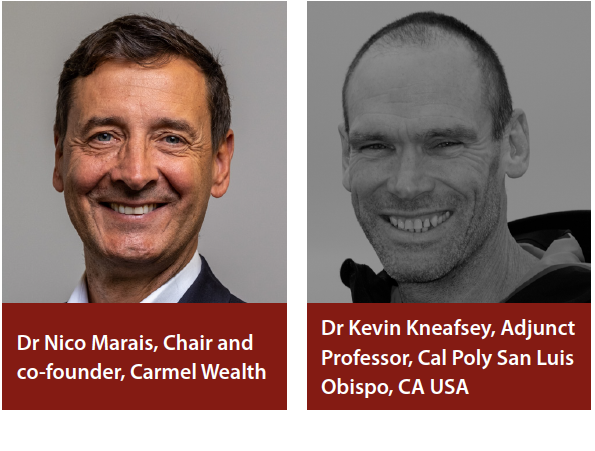
• Article written by Dr Nico Marais (Chair and co-founder, Carmel Wealth) and Dr Kevin Kneafsey (Adjunct Professor, Cal Poly San Luis Obispo, CA USA).